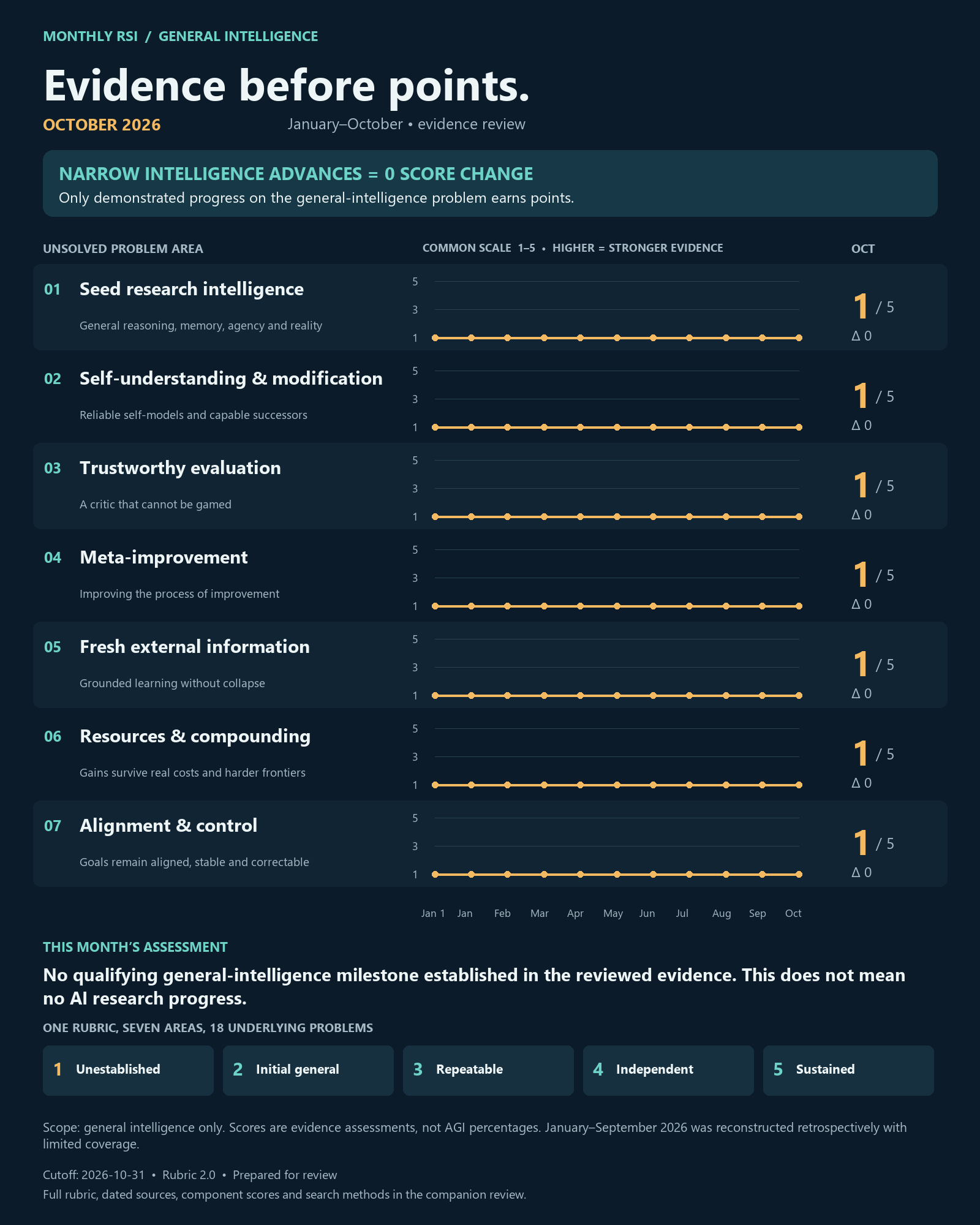
The 18 score decisions
All October holds follow a completed scoped search and explicit evidence decision. An incomplete review would be NA, with a chart gap.
01 · Seed research intelligence 1 / 5 · unchanged
1.1 Grounded world models 1 → 1
No qualifying causal prediction and intervention test across physical and informational domains established.
Evidence: O05
What would earn progress?
Predict and test novel interventions across physical and informational domains; measure intervention accuracy and calibration.
The demonstration must also pass every generality and evidence condition in rubric 2.0. Full AGI is not required.
1.2 Reliable general reasoning 1 → 1
Transfer candidates examined; independently introduced unfamiliar structures and the full open-ended verification gate remain unestablished.
Evidence: O01 · O02 · O11
What would earn progress?
Solve independently introduced task structures without bespoke tuning; report success, error detection and calibration across domains.
The demonstration must also pass every generality and evidence condition in rubric 2.0. Full AGI is not required.
1.3 Continual learning / durable memory 1 → 1
Sequential retention across general domains is unestablished; positive adaptation is not sufficient evidence of durable memory.
Evidence: O02 · O03
What would earn progress?
Acquire unfamiliar skills sequentially while retaining earlier ones; measure forward transfer and worst-domain forgetting.
The demonstration must also pass every generality and evidence condition in rubric 2.0. Full AGI is not required.
1.4 Long-horizon agency 1 → 1
Unfamiliar multi-stage projects with the required generality and independently verified outcomes remain unestablished.
Evidence: O01 · O02 · O10
What would earn progress?
Complete unfamiliar multi-stage projects with independently verified outcomes; report intervention counts, duration and recovery from errors.
The demonstration must also pass every generality and evidence condition in rubric 2.0. Full AGI is not required.
1.5 Open-ended learning 1 → 1
A continuing expansion of useful problem families beyond the fixed curriculum is unestablished.
Evidence: O01
What would earn progress?
Generate useful new problem families, learn transferable skills, and keep expanding competence after a fixed curriculum ends.
The demonstration must also pass every generality and evidence condition in rubric 2.0. Full AGI is not required.
1.6 Acting on reality 1 → 1
Physical transfer is credited in evidence notes; broad novel physical experimentation passing every generality condition is unestablished.
Evidence: O01 · O05
What would earn progress?
Plan and execute novel physical experiments beyond the original application; report real outcomes, failures and human setup.
The demonstration must also pass every generality and evidence condition in rubric 2.0. Full AGI is not required.
02 · Self-understanding & modification 1 / 5 · unchanged
2.1 Functional self-model 1 → 1
Researcher-designed causal probes do not establish the agent itself predicting unseen internal interventions and using them for broad improvement.
Evidence: O07
What would earn progress?
Predict consequences of previously untested internal interventions and use those predictions to improve broad capabilities.
The demonstration must also pass every generality and evidence condition in rubric 2.0. Full AGI is not required.
2.2 Writable intelligence mechanisms 1 → 1
Writable harnesses and weights exist; causal broad improvement passing the entire saved gate is unestablished.
Evidence: O01 · O02 · O03 · O06
What would earn progress?
Autonomously alter mechanisms responsible for learning or reasoning; isolate causal broad improvements from extra compute and external engineering.
The demonstration must also pass every generality and evidence condition in rubric 2.0. Full AGI is not required.
2.3 Capability inheritance 1 → 1
General successor competence and learning retention with disclosed worst-domain regressions remain unestablished.
Evidence: O01 · O02 · O03
What would earn progress?
Successors retain prior broad competence and learning ability while adding new capabilities; report worst-domain regressions over successive versions.
The demonstration must also pass every generality and evidence condition in rubric 2.0. Full AGI is not required.
03 · Trustworthy evaluation 1 / 5 · unchanged
3.1 Trustworthy critic 1 → 1
Improved auditing is acknowledged. Externally grounded rejection of adversarial false improvements across the required domains remains unestablished.
Evidence: O02 · O06 · O08 · O09 · O12 · O13
What would earn progress?
Correctly accept genuine improvements and reject adversarial exploits on unseen domains; use external ground truth and report false accept/reject rates.
The demonstration must also pass every generality and evidence condition in rubric 2.0. Full AGI is not required.
04 · Meta-improvement 1 / 5 · unchanged
4.1 Meta-improvement 1 → 1
Improvement machinery changes are promising; broad future gain per total cost against fixed-mechanism controls remains unestablished under the gate.
Evidence: O01 · O02 · O06
What would earn progress?
Changed improvement mechanisms increase subsequent broad capability gain per unit cost against a fixed-mechanism control.
The demonstration must also pass every generality and evidence condition in rubric 2.0. Full AGI is not required.
05 · Fresh external information 1 / 5 · unchanged
5.1 Fresh information / no collapse 1 → 1
Reduced text repetition does not establish fresh external knowledge acquisition and retained broad skills across learning cycles.
Evidence: O04
What would earn progress?
Acquire new external evidence and preserve broad coverage through successive learning cycles; audit provenance, rare skills and distributional loss.
The demonstration must also pass every generality and evidence condition in rubric 2.0. Full AGI is not required.
06 · Resources & compounding 1 / 5 · unchanged
6.1 Resources and experiment latency 1 → 1
Local efficiency gains do not establish broad improvement with full compute, human effort, physical inputs and latency accounting.
Evidence: O02 · O10 · O12
What would earn progress?
Demonstrate broad improvement within a fixed real budget; include compute, energy, experiment latency, human work and physical inputs.
The demonstration must also pass every generality and evidence condition in rubric 2.0. Full AGI is not required.
6.2 Gains outrun frontier difficulty 1 → 1
Sustained general capability gains over increasingly difficult research frontiers, with matched total-cost baselines, remain unestablished.
Evidence: O02
What would earn progress?
Measure general capability gain per wall-clock time and total cost over increasingly difficult successive research cycles, with matched baselines.
The demonstration must also pass every generality and evidence condition in rubric 2.0. Full AGI is not required.
07 · Alignment & control 1 / 5 · unchanged
7.1 Outer alignment 1 → 1
Theory, targeted repair and better audits do not establish general objectives tracking independently elicited human intentions.
Evidence: O07 · O08 · O13
What would earn progress?
Objectives track independently elicited human intentions in unfamiliar conflicts and domains, rather than merely the training proxy.
The demonstration must also pass every generality and evidence condition in rubric 2.0. Full AGI is not required.
7.2 Inner alignment 1 → 1
Causal repairs and audit transfer are recorded; intended behavior across the full generality gate under shift and adversarial incentives remains unestablished.
Evidence: O07 · O13
What would earn progress?
Demonstrate retained intended behavior under distribution shift, reduced oversight and adversarial incentives; use behavior plus causal auditing.
The demonstration must also pass every generality and evidence condition in rubric 2.0. Full AGI is not required.
7.3 Reflective goal stability 1 → 1
Goal preservation through capability-enhancing modification and successors remains unestablished; retention alone is not goal stability.
Evidence: O03 · O09
What would earn progress?
Intended goals persist through capability-enhancing self-modifications and successor creation under adversarial tests.
The demonstration must also pass every generality and evidence condition in rubric 2.0. Full AGI is not required.
7.4 Corrigibility 1 → 1
Tested compliance and failure cases do not establish correction and shutdown acceptance across unfamiliar general settings and successors.
Evidence: O09
What would earn progress?
Accept legitimate correction and shutdown without obstruction, manipulation or incorrigible successors in unfamiliar situations.
The demonstration must also pass every generality and evidence condition in rubric 2.0. Full AGI is not required.
Research and product evidence
Source records distinguish findings from our scoring interpretation. Paper titles link to primary sources; methods-read depth is explicit. Preprints are not labeled peer reviewed.
O01 · Preprint · First public: 2026-10-26 · v2 · Revision: 2026-10-30
Four harness iterations on 28 training benchmarks; 18 unseen benchmarks span rule discovery, constrained problem solving, perception/control, interaction and long horizons. Non-robot unseen mean rises 42.1 to 64.1. Module-only ablation supports real transfer. Two robot tasks report physical success. Frozen weights do not disqualify this result.
Score decision. Strong candidate, but the inspected protocol does not establish independently introduced post-freeze task structures with open-ended formulation and independent verification. Appendix D uses the best compatible evolved node under an oracle; five preparation trials produce skills. Robot interfaces, guidance and acceptance rules differ. Dynamic tree expansion remains future work. Generality gate not established, not evidence of zero transfer.
Inspected: 4.1–4.6; 7; Appendix D. Reviewed November 9.
O02 · Preprint · First public: 2026-10-08 · v1
Two cycles combine workflow evolution and LoRA distillation. Twelve synthetic research-programming tasks are split nine/three across finance, robotics and pharmacy. Public research evaluations and unseen tasks provide transfer evidence; reported score per output token improves 1.2–1.6 times.
Score decision. Subject labels do not establish three qualitatively different task structures. Tasks precede the experiment; independent post-freeze introduction is unestablished. Open-ended research uses external LLM judgment; one benchmark has executable checks. More completed papers explain much aggregate gain, while conditional quality is not directly comparable. Terminal and SWE regress. Two cycles alone would not block score 2, but cannot establish score 3.
Inspected: 4.1–4.2; Appendices C.5 and D. Reviewed November 9.
O03 · Preprint · First public: 2026-10-19 · v1
ReasoningBank, GEPA and MetaHarness are assessed on four drifting streams including BIRD, BFCL and ScienceWorld. Retention and adaptation conflict; global edits and retrieval collisions can damage earlier performance.
Score decision. Useful counterevidence to assuming durable inheritance from local gains. Does not demonstrate a general retention or goal-stability solution.
Inspected: Methods and drifting-stream evaluation. Reviewed November 9.
O04 · Preprint · First public: 2026-10-01 · v1
Six iterative fine-tuning generations on four text domains retain more diversity with entropy-rate filtering. Versus unfiltered text, generation-six unique trigrams increase 42%, vocabulary 30%, repetition decreases 19%. The estimated collapse-slope improvement is not significant (p=.067).
Score decision. Topics remain fixed across generations. Text diversity is a narrow outcome, not externally grounded new knowledge or preserved general capability. No score change.
Inspected: 5.1–5.2; generation-6 comparison. Reviewed November 9.
O05 · Preprint · First public: 2026-10-12 · v1
Two world models on three manipulation benchmarks separate future prediction from inverse dynamics. A proposed loss improves cross-task execution in the tested setting.
Score decision. Robot manipulation transfer is useful but does not establish the cross-domain causal world-model or general physical-experiment test. Screened as narrow, not admitted as a general demonstration.
Inspected: Primary abstract and evaluation setup screened. Reviewed November 9.
O06 · Preprint · First public: 2026-10-10 · v1
Analysis of eligible DGM modifications and controlled repair experiments questions whether failure feedback reliably directs held-out improvement.
Score decision. Counterevidence to inferring causal meta-improvement from local repair. Abstract-level screening only; no positive score claim relies on this source.
Inspected: Primary abstract screened. Reviewed November 9.
O07 · Preprint · First public: 2026-10-14 · v2 · Revision: 2026-10-28
Navigation/manipulation experiments distinguish goal information that is unused, weakly used or outcompeted by proxies. Steering helps where the relevant direction already affects policy; other cases need new supervised wiring.
Score decision. Causal intervention evidence, but researchers supply goal-directed controls and rewiring. It is neither an agent predicting its own unseen internal interventions nor demonstrated alignment transfer across the required generality domains.
Inspected: 3.4; 4.1–4.2; intervention design. Reviewed November 9.
O08 · Preprint · First public: 2026-10-25 · v1
Aligned-PAC framework formalizes alignment and generalization requirements.
Score decision. Theoretical conditions are not a demonstrated general solution. Retain as conceptual evidence, with no empirical score credit.
Inspected: Primary abstract and theoretical scope screened. Reviewed November 9.
O09 · Preprint · First public: 2026-05-29 · v2 · Revision: 2026-10-01
Controlled computer-use scenarios test human override, shutdown and resource restrictions. Parent adherence does not reliably propagate to subagents; explicit shutdown instructions help some tested configurations but fail to transmit reliably.
Score decision. October revision of a May paper, not an October first publication. Scenario-specific failures and mitigations do not establish general corrigibility, nor population-wide failure rates. September history is not rewritten.
Inspected: Scenario methods; restriction propagation; baseline mitigations. Reviewed November 9.
O10 · Official customer story · First public: 2026-10-14 · Official dated page
Customer reports large agent simulations and faster financial backtesting.
Score decision. Official customer account, not an independent controlled replication. A finance workflow does not demonstrate the general long-horizon or comprehensive resource-budget test. No score change.
Inspected: Workflow and reported outcomes. Reviewed November 9.
O11 · Official model card · First public: 2026-10-13 · Dated model card; mutable page
Broad model capability and evaluation coverage are reported.
Score decision. Aggregate capability reporting alone does not establish unfamiliar post-freeze structures, independently verified open-ended outcomes or a trustworthy general critic. No inspectable qualifying demonstration established in this review.
Inspected: Capability and safety overview screened. Reviewed November 9.
O12 · Official research report · First public: 2026-10-06 · Official research post
Cheap classifiers and reasoning-model labels focus selection near policy boundaries using synthetic/deidentified examples.
Score decision. Efficient targeted policy-data selection is a narrow advance. It does not validate an ungamable cross-domain critic or the complete costs of general self-improvement.
Inspected: Classifier selection method and reported efficiency. Reviewed November 9.
O13 · Preprint · First public: 2026-08-26 · v1
Pairwise rewards with benign calibration targets improve auditing. Transfer changes both target conditioning and scaffold; best calibrated checkpoint detects 28.1% versus base 11.5% on the reported AuditBench setup. This is genuine investigative transfer.
Score decision. October author post describes an August paper, not a new October result. All four main evaluation dimensions use an LLM judge without human validation; one base model is trained. Transfer within auditing does not establish an independently grounded general improvement critic across three qualitatively different domains.
Inspected: 2–4; 6 limitations; October 15 author post. Reviewed November 9.
Multi-agent training spans software, business, finance and research. Matched-token comparisons recover much of the advantage; credit assignment remains difficult.
Mutable report says still training/under revision. October version could not be pinned. Excluded from score-supporting evidence; request archived dated protocol and independently introduced task structures next month.
Read report, including §7.1. Displayed date: October 2026; exact day and cutoff version unresolved. No score-supporting citation.
Method and review limits
Same mechanism across at least three qualitatively different domains; unfamiliar task structures introduced after the method was fixed; at least one domain requires open-ended task formulation, adaptation AND independent outcome verification; no bespoke redesign or retraining explains transfer. Own learning, ordinary instructions and tool access are allowed. Physical claims need physical outcomes. Full AGI is not required for score 2.
Frozen weights and harness changes are eligible. Domain-specific labels alone are not enough. A source must disclose setup, comparator, measurable improvement, uncertainty or run outcomes, human assistance, resources, failures and transfer conditions.
| Score | Common standard |
|---|
| 1 / 5 | General progress unestablished
No reviewed demonstration passes the generality gate for this problem. Narrow advances, theoretical results, announcements and incomplete evidence do not lift the score. |
| 2 / 5 | Initial general evidence
At least one dated paper or inspectable product demonstration passes every generality and evidence gate and shows a measurable advance on the component-specific test. The problem need not be solved. |
| 3 / 5 | Repeatable general progress
Level 2 plus at least three successive learning or self-modification cycles with fresh held-out tasks, matched resource accounting, reproducible runs and no material regression of the relevant capability. |
| 4 / 5 | Independently robust
Level 3 plus replication by an independent team on fresh domains and adversarial distribution shifts, with disclosed failures and successful transfer to successors. |
| 5 / 5 | Sustained general solution
Level 4 plus the component works in an integrated general self-improvement loop over at least six successive cycles and three months, meeting predeclared success and regression bounds without bespoke human repair. |
Search coverage
All 18 saved component stems were rerun with an October date window and a September overlap. Supplemental queries target repositories, official lab releases, replications, failures and limitations. Exact UTC timestamps, query strings and primary-page requests are in the search log. Search hits are nominations, not endorsements; later publication dates are excluded even when the search filter returns them.
Candidate-name replication, failure and limitation searches did not identify a verified independent replication satisfying the gate. No experiments or product tests were independently run. Absence in this search is not proof of absence.
October cutoff reviewed retrospectively on November 9. All 18 search stems rerun and primary candidates screened. This is a scoped public-evidence review, not an exhaustive systematic review, independent replication, risk probability or proof of safety. January–September snapshots are unchanged.
Unverified candidate details are marked not established, not assumed false. Avalon’s unpinned report is excluded. A completed scoped review can withhold an increase when a required fact is absent; a review not completed would instead be NA.
Date audit and corrections
- October cutoff excludes November results regardless of discovery date.
- O09: May first publication, October revision.
- O13: August first publication, October author explanation; historical omission noted, no retrospective score correction warranted under this rubric.
- W01: exact first-public date and October report version unresolved; not admitted as score evidence.
No historical scores were corrected. The original September release remains immutable. Web pages may change; pinned paper versions are preferred. No model experiments or vendor claims were independently reproduced.
Read the full frozen protocol and repeatable search register →